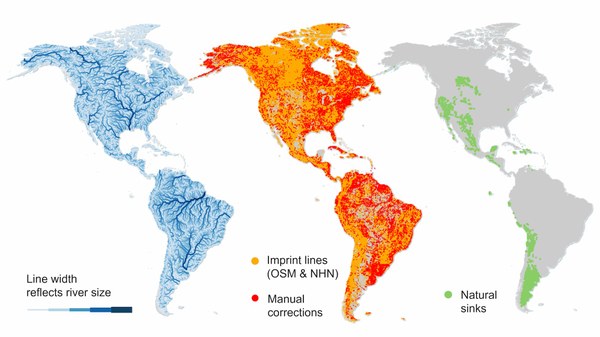
Newsletter - SEPTEMBER 2026 Upstream Accumulation Area Now Available for the AmericasWe are releasing the Upstream Accumulation Area (ACA) dataset for the Americas, the latest addition to the growing HydroSHEDS v2 product suite.
The ACA is a flow accumulation raster is derived from the HydroSHEDS Flow Directions (DIR) dataset. It quantifies the total upstream area, in square kilometers, that are contributing to each grid cell. This provides a more convenient and meaningful area metric to support a variety of hydrological applications. The dataset is available for download by tile or region through the HydroSHEDS v2 data download page.
New Feature: Recent Publications from the CommunityStarting with this issue, we are introducing a new section dedicated to the growing body of research that uses HydroSHEDS data and products.
Each newsletter will highlight a selection of papers published over the last 4 to 6 weeks, giving you a glimpse of how HydroSHEDS is being applied across disciplines and regions.
We find it inspiring to see the many ways the community is using HydroSHEDS, and we hope you will enjoy exploring these recent contributions as much as we do. Recent Publications from the CommunityFrom vertical to volumetric constraints: Basin shape mediates oxythermal fish habitat compression Detmer, T. M. (2026). Hydrobiologia. Tag: HydroLAKES.
Read article.
A Review of the Fate and Effects of Selected Low- and No-Calorie Sweeteners and Their Probabilistic Risk to Aquatic Organisms Guiney, P. D., & Holmes, C. M. (2026). Integrated Environmental Assessment and Management. Tag: HydroFATE.
Read article.
Inventorying national direct emissions of ammonia, nitrogen oxides and nitrous oxide from managed soils using process modelling-based Tier 3 methodology Li, S., Zhang, W., Han, S., Li, Y., Liu, C., Yao, Z., Wang, R., Wang, K., Chen, X., Wang, C., & Zheng, X. (2026). Advances in Climate Change Research. Tag: HydroSHEDS.
Read article.
Who dams, who bears: Transboundary responsibility and inequality of global river damming Li, Y. (2026). Environmental Research Letters. Tag: HydroBASINS.
Read article.
Machine learning-driven flood susceptibility mapping in the coastal frontier of Feni District, Bangladesh Misty, M. S., Hasan, M., Hoque, M. A.-A., Islam, Md. K., Nayem, A. M. M. J., Uddin, N., & Pradhan, B. (2026). Geomatics, Natural Hazards and Risk, 17(1), 2717863. Tag: HydroSHEDS.
Read article.
Assessment of System Order Risk and Resilience with Modeled Societal and Hydrologic Variables Pavur, G., Marcellin, M. C., Loose, D. C., Gunn, M. E., Gunn, M. C., Trump, B. D., Linkov, I., Lakshmi, V., & Lambert, J. H. (2026). 2026 12th International Conference on Control, Decision and Information Technologies (CoDIT), 1027–1032. Tag: HydroSHEDS, HydroBASINS.
Read paper.
Hydrochemical response of urban Himalayan rivers to land use change and water quality degradation. Rana, D., Joshi, N., Nandan, A., Alsubih, M., & Jelila, Y. D. (2026). Scientific Reports. Tag: HydroSHEDS.
Read article.
A baseline of surface water connectivity in European Ramsar wetlands Robinson, A. E., & Jaramillo, F. (2026). Communications Earth & Environment, 7(1), 658. Tag: HydroSHEDS, GLWD.
Read article.
Deciphering riverine CODMn sources: Driver identification and carbon cycle impacts Shang, Y., Wen, Z., Liu, G., Fang, C., Yu, X., Liu, J., & Song, K. (2026). Ecological Indicators. Tag: HydroBASINS.
Read article.
Climate-policy pathways reshape cropland-expansion-driven deforestation and agricultural-carbon trade-off imbalance in the Amazon Shen, W., Zhang, Z., de Vries, W. T., Yang, Y., Gao, H., & Niu, L. (2026). Land Use Policy, 171, 108277. Tag: HydroBASINS.
Read article.
Prediction of the distribution of a key species for the restoration and conservation of Brazilian riparian ecosystems under climate change Silva, C. C. L. B. da. (2026). Universida de Estadual de Maringá, Dep. de Biologia, Maringá. Tag: HydroSHEDS.
Read thesis.
Loss Functions Matter: A Systematic Study of Class Imbalance in Flood Forecasting Van Trang, N. T., & Nguyen, V.-L. (2026). 2026 IEEE International Conference on Image Processing (ICIP), 1–6. Tag: HydroATLAS.
Read paper.
Decoding microplastic pollution in China freshwater: Interpretable machine learning insights into composition-specific distribution and associated phthalate ester leaching risk Wan, X., Guo, Q., Han, Z., Jiang, T., Chai, G., Tong, Y., Cui, H., & Cui, X. (2026). Water Research, 307. Tag: HydroATLAS.
Read article.
Predicting habitat suitability of pollution-sensitive macroinvertebrates under climate change using climate and land use predictors in Ethiopia: An ensemble modeling approach Worku, Y., Asmamaw, M., Melese, D., & Ambelu, A. (2026). Ecological Processes, 15(80), 80. Tag: HydroSHEDS.
Read article.
A wavelet–LSTM framework for mapping large inland water bodies using CYGNSS observations Yang, Y., Hu, Y., & Li, Z. (2026). Journal of Hydrology: Regional Studies, 67, 103854. Tag: HydroLAKES.
Read article.
Biodiversity and food web structure in relation to hydrological connectivity in a boreal stream ecosystem Zhang, J., Wang, H., Song, Y., Liu, Y., Zhang, S., & Yin, X. (2026). Water Biology and Security, 100714. Tag: HydroSHEDS.
Read article.
Overwhelming wetland reclamation confronts severe flood risks Zhang, X., Dong, J., Shang, Y., Chen, X., Wang, X., Zhang, Q., Liu, R., Peng, S., Mao, D., He, X., Ge, Y., & Xiao, X. (2026). Science Bulletin. Tag: HydroBASINS, HydroATLAS.
Read article.
Essential Biodiversity Variables (EBVs) as an Optimal Format for Habitat Suitability Index of the Black-Necked Crane Across Life Stages Zhong, Y., Li, X., Guo, Y., Wang, Y., Jia, J., Xie, W., Fang, Y., & Sun, Y. (2026). Diversity, 18(8), 486. Tag: HydroATLAS.
Read article.
We are also on:


HydroSHEDS Created, curated, and maintained by Confluvio and partners.
You are receiving this email because you subscribed to HydroSHEDS updates.
Copyright 2026 HydroSHEDS. All rights reserved. |